
If you’re brand new to ecommerce, there’s one growth strategy that beats everything else. It’s not fancy software. It’s not learning complex ads. It’s not waiting until you have “more money saved.”
 It’s reinvesting your profits.
This is the exact strategy we used to generate more than $40 million in Amazon sales over the last decade. And it’s the strategy that almost every successful seller we’ve coached has used to turn their small start into something substantial.
A snowball starts small. But once it begins rolling, every turn adds more mass. Then the next turn adds even more. Before long, it becomes unstoppable.
Reinvestment is the business version of that snowball.
No profit margin or ROI is guaranteed per se, but many products have a 15% Profit Margin / 30% Return on Investment or more when buying at Wholesale Pricing. No matter the numbers, if they’re positive, you’re compounding orders size and profits month to month.
Let’s start with the mindset shift that unlocks everything.
Why Reinvesting Is the Fastest Growth Strategy
Most new sellers believe they need a huge amount of money to make ecommerce “worth it.” They wait until they’ve saved $5,000… or $10,000… or they delay for months because they aren’t sure they’ll “have enough to make it work.”
The truth is the opposite. You can start with small test buys until you’ve seen the profits roll in from Amazon,
Small amounts, reinvested consistently, grow faster than large amounts invested once.
Here’s why:
1. Reinvestment compounds your results
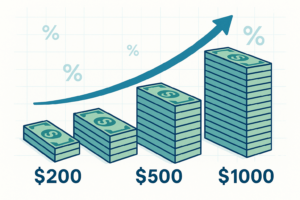
If you earn a 30% return on a purchase (which is an ideal we strive for in wholesale), that profit gets added to your original amount.
Then the next time you buy inventory, you’re buying with a larger base.
And the larger the base, the larger the profit—even if the percentage stays exactly the same.
This is identical to compound interest, except faster, because ecommerce cycles (buy → sell → reinvest) happen in weeks instead of years.
 2. You lower risk by learning small
When you reinvest profits instead of pouring in new money, you allow your experience and your skills to grow alongside your capital.
You learn:
- How to evaluate product demand
- How to communicate with suppliers
- How to time inventory orders
- How to avoid buying too deep too early
You learn these things with small amounts—so mistakes don’t hurt.
3. You create “momentum confidence”
Momentum is a powerful force for entrepreneurs.
Your first sale gives you confidence.
Your first profitable restock raises that confidence.
Your first product that sells out faster than expected raises it even more.
Before long, you’re no longer asking, “Will this work?”
You’re asking, “How fast can I scale this?”
Momentum is built through reinvestment.
What Realistic ROI Looks Like for New Sellers
We’re not going to give you inflated metrics.
Here’s what we see every week with new students following our wholesale method:
 Typical profit margins
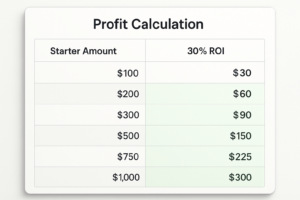
Most new wholesale sellers land between 20%–35% ROI (return on investment) on their first profitable test buys.
Those numbers climb as you get better at evaluating suppliers and demand.
Typical starter buy sizes
To test a product, many new sellers start with:
- $200 test buy
- $500 test buy
- $1,000 test buy
Your goal is to gather data quickly, safely, and with small amounts.
Now let’s walk through realistic scenarios so you can see how reinvestment works in real life.
Example #1: A 30% return on a $200 test buy
Let’s say you buy $200 worth of inventory.
You get a 30% return.
That means you make $60 profit, and your total amount after selling out is:
$260
You reinvest the $260.
Next cycle, you make another 30%:
$78 profit → total now $338
You reinvest again.
After several cycles, that same starting $200 has practically doubled—without adding more cash.
Example #2: A 30% return on a $1,000 test buy
Now imagine starting with $1,000.
30% ROI gives you $300 profit → total $1,300
Reinvest:
30% again → $390 profit → total $1,690
Reinvest:
30% again → $507 profit → total $2,197
Your money more than doubled in three monthly cycles in this example of what’s ideal.
This is the power of reinvestment.
How to Map Out Growth From $500 → $5,000 → $50,000
This is the part new sellers love.
It shows you exactly what is possible with consistent reinvestment and no complicated math.
Below is a simplified growth path using 30% ROI per cycle.
This is not a guarantee. This is a model to show why reinvestment works so well.
Starting Amount: $500
Cycle | Amount After Reinvestment |
1 | $650 |
2 | $845 |
3 | $1,098 |
4 | $1,427 |
5 | $1,855 |
6 | $2,412 |
7 | $3,135 |
8 | $4,075 |
By cycle 3, many students begin adding a second or third product.
Scaling to $5,000
Cycle | Amount |
9 | $5,297 |
10 | $6,886 |
Even without adding new cash, the snowball continues to build.
Scaling to $50,000
If you keep reinvesting, adding profitable products, and avoiding big “overbuy” mistakes, here’s what continued compounding looks like:
Cycle | Amount |
15 | ~$25,000 |
18 | ~$50,000 |
Again, this is a simplified model. In reality, you may hit 20% ROI some cycles, 45% others, or you may mix in multiple products at once.
But the principle stays the same:
Reinvest. Let the snowball roll. Keep going.
 Why This Growth Model Works Even If You Have a Full-Time Job
One of the biggest misconceptions about ecommerce is that you need to do it full-time to see results.
That is absolutely false.
Wholesale is the perfect model for people with full-time jobs because:
- You only buy what is already selling well
- You don’t create or invent anything
- You don’t have to run ads
- You don’t have to go “viral”
- You don’t need to be a marketer or influencer
- You spend most of your time restocking products that already work
Your business grows on the strength of the products you choose and your willingness to reinvest profits.
Not on the number of hours you have available.
The Biggest Mistake New Sellers Make (And How to Avoid It)
The #1 mistake new sellers make is this:
They pull profits out too early.
They hit their first $1,000 month.
It feels great.
They want to “reward” themselves.
So they take $200 out.
Then another $200.
Then another.
Suddenly their snowball stops rolling.
Here’s the truth:
Your business will give you much bigger “rewards” if you leave the profits in for a few more months.
Once your snowball reaches real mass—$10,000… $20,000… $50,000—then you can take consistent profit without slowing growth.
The early stages are for feeding the snowball, not starving it.
How to Start Your Reinvestment Plan Today
Here is the simple plan we have thousands of students follow:
 Step 1: Start with what you have
Whether it’s $200, $500, or $1,000, it’s enough.
Step 2: Run small test buys
Use test buys to learn:
- Demand
- Supplier reliability
- Profit margins
You’re collecting data, not gambling.
Step 3: Reinvest 100% of profits for the first 3–6 months
This is where your snowball forms. You can’t always use 100% of the profits on reordering, but that’s ideally the fastest trajectory here.
Step 4: Add new products slowly
Not all at once. Use around 10% of your monthly revenue on new test buys, the rest on reorders.
One good restock is better than five guesses.
Step 5: Increase order size only when data proves demand
Trust the numbers, not your emotions.
You Don’t Need a Perfect Start — You Need a First Step
Most people don’t fail because the business model is hard.
They fail because they wait too long.
They delay.
They tell themselves they “need to learn more” or “need more money.”
Meanwhile, their snowball isn’t growing because it never started rolling.
The Wholesale Formula was built for beginners who want a smart, low-risk, data-driven way to grow an online business.
And our next free workshop shows you exactly how to do it.
Quick Summary
- Reinvesting profits is the fastest way to grow with low risk
- 20%–35% ROI is common on test buys ($200–$1,000)
- Compounding turns small amounts into big results
- A $500 start can grow toward $5,000 → $50,000 with consistent reinvestment
The biggest mistake beginners make is taking profits too early