

Top 3 Strategies to Avoid Thousands in New 2026 FBA Inventory Fees
Amazon changed the rules in January that created a problem most newer sellers have not fully solved yet. If you’re planning to sell on Amazon through the FBA program, here are some money-saving strategies to outmaneuver the competition.
Amazon now evaluates your low-inventory fee at the individual FNSKU level instead of the parent ASIN level. That means 500 units of Black, Large does nothing for another variation like Black, Small. If Black, Small drops below 28 days of supply, that variation triggers an additional small fee on every single sale until you restock it.
Some sellers are losing up to 10% of their revenue on a SKU without knowing it.
The fix, once you know what to look for, takes a few minutes and some diligence. But the sellers who find it late are paying for every day they missed it.
This is not a warehouse problem. It is a cash flow problem. And the sellers who understand that distinction early are the ones who stay profitable when others are confused about why their numbers aren’t adding up.

Strategy 1: Run a Weekly FNSKU Level Inventory Audit
The single most important habit you can build right now costs nothing and takes about 15 minutes a week.
Go into Seller Central and pull your FBA Inventory report. Sort it by days of supply, lowest to highest. You are looking for any FNSKU sitting below 35 days of supply. Not 28. Thirty-five, because you need buffer time to reorder, ship, and receive before you cross the line.
Set a standing weekly appointment on your calendar and treat it like a bill due date. Because that is exactly what it is.
Three things to look for in your audit:
- Any FNSKU under 35 days of supply. Flag it and reorder immediately.
- Slow-moving variations. A size or color that sells one unit a week needs far less reorder volume than your top mover, but it still needs to stay above the threshold.
- Seasonal variations. If you sell anything that moves faster in certain months, your supply calculation can mislead you. Most software like SmartScout will show historical data going back over a decade now.
The audit is not complicated: it just has to happen consistently, every week, without exception.
Strategy 2: Reorder by Variation, Not by Product
Most new sellers think about restocking at the product level. They look at a listing and think, “I need more of this.” Then they place an order that covers their top two or three variations and let the slower ones trail. Under the old rule, that was fine. Under the new rule, it is expensive.
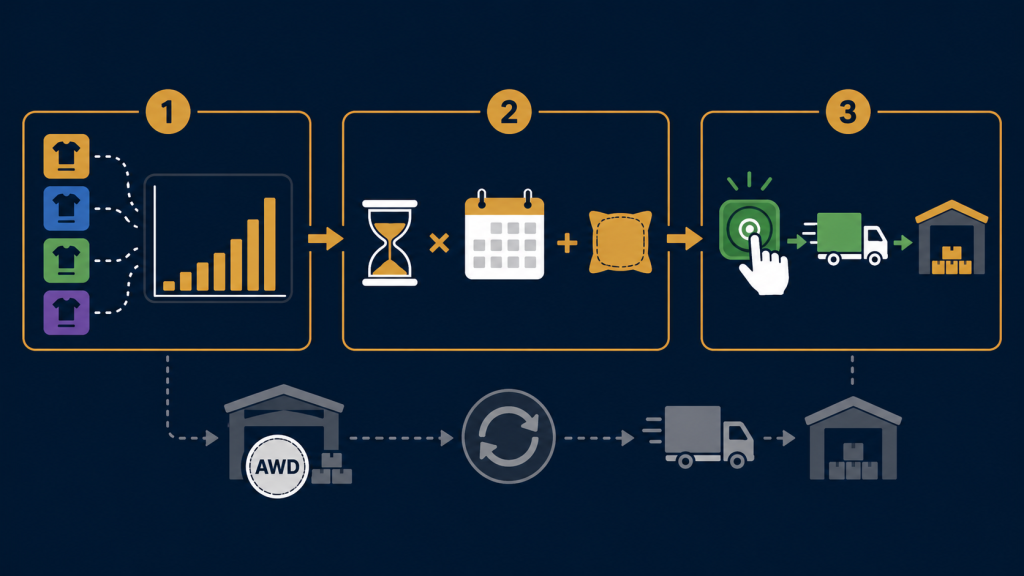
Every variation needs its own reorder point, its own lead time calculation, and its own replenishment trigger. Here is a simple framework:
Step 1: Use Inventory tools in Seller Central to track “daily sales” for each variation over the last 30-45 days.
Step 2: Multiply that number by your supplier lead time in days, then add 7-14 as a safety buffer depending on Inventory Space.
Step 3: When your current inventory hits that number, reorder. Not when it feels low. When the math says so.
One additional option in Seller Central: enrollment in Amazon Warehousing and Distribution, called AWD, waives low-inventory fees entirely for enrolled products and handles automatic replenishment. It is not right for every SKU, but for high-volume variations with consistent demand it’s ideal.
Strategy 3: Use Third Party Tools to Stay Ahead of the Fee
Amazon-partnered tools that show you insights above and beyond boilerplate Seller Central. Most sellers consider these but do not take them seriously.
- Third Party tools give you many more insights, and have flexibility in UI and custom tags for tracking/metrics.
- They also allow variables for Ad Campaigns and other inorganic sources of expected sales if you are spending on promos or launches.
- 3P tools like SellerLegend also have better reporting and analytics on the back-end with those custom tags to make reorders faster.
The Bigger Lesson
You do not need expensive tools or long hours to succeed, you need a consistent system.
Fifteen minutes a week on your audit. A reorder formula by variation. A monthly look at your Fee Preview report. That is the difference between paying fees you did not know existed and holding your margin quarter after quarter.
Keep working on building new systems and processes, and you will become more efficient in no time. Consistency is what primarily leads to incremental growth.