

Give me a laptop, one free weekend, and a bank balance that needs to move. No email list, no followers, and no funnel quietly working in the background.
By Sunday night I’d have an extra $500 in the account.
And I’d care far more about how it got there than about the number itself.
Here’s the mistake almost everyone makes before they even open the laptop. They sit down on Saturday morning and ask, “what business should I start?” That’s a fine question for January. It’s the wrong one for this weekend. What puts money in the account by Sunday is simpler to answer: “what can I do for someone right now that they’ll happily pay me for by tomorrow?” The two sound close on paper, and they lead to completely different weekends.
Why the First Sale Beats the First $500
The money is just the receipt. What you’re really chasing is the sale behind it.
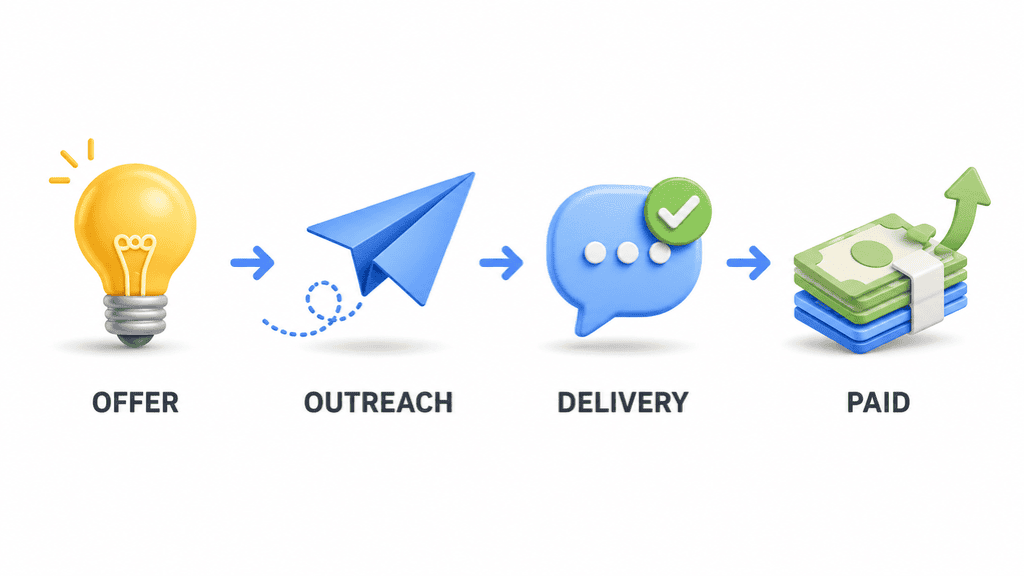
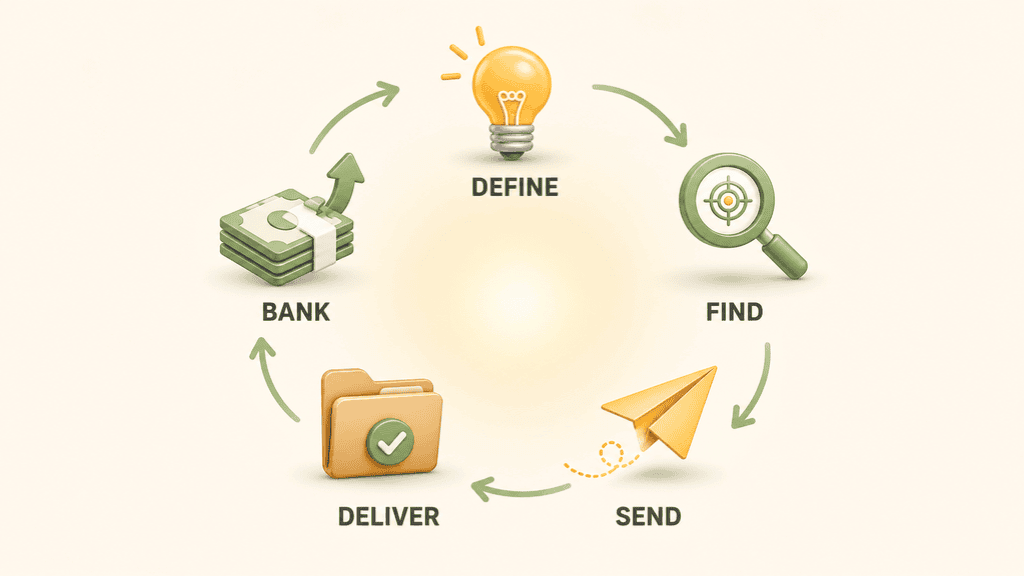
When you earn your first $500 from a standing start, you prove something that no course, podcast, or motivational video can prove for you. You prove the loop closes. You can define an offer, find the people who need it, send the message, do the work, and collect the payment. That loop is the shape of every online business that has ever worked, at any size.
Most people spend a year or more trying to feel that for the first time, because they build the whole thing backwards. Website first, then a product, then a list, then traffic, and somewhere near the end, almost as an afterthought, an actual offer. By the time they ask anyone for money, the savings are gone and so is the motivation.
The weekend sprint runs the same loop forwards, at the smallest scale that still counts as real. Once you’ve run it over two days, you can run it over a month, then a quarter. The scale changes. The five steps don’t.
The One Rule: People Pay for Finished Outcomes
Everything in this sprint rests on a single rule. People pay for a finished, specific result that fixes a problem they’re already trying to fix. They don’t pay for a “consultation” or “a chat about their options” or “access to my process.” They pay for the thing that’s done.
Compare these two sentences:
- “I help online stores grow.”
- “I’ll rewrite your five worst-performing product pages and have them back to you by Sunday at 8pm.”
The first gets ignored. The second gets a reply, because the buyer can picture the finished result and knows exactly what they’re saying yes to. Narrow your offer until a stranger can read it in one breath and know whether they need it.
The Plan, Hour by Hour
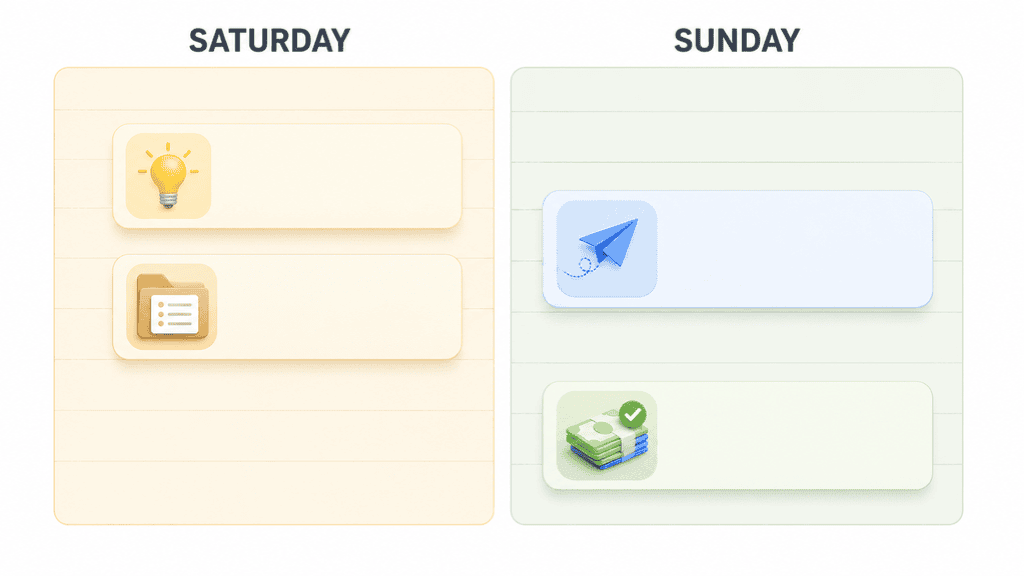
Saturday morning: pick one thing you’ve already done
Choose a single task you have genuinely done before, ideally for your own projects. Not what you wish you could do. What you’ve actually done at least once.
Maybe you set up a welcome email sequence for a side project. Maybe you’ve written comparison tables for an affiliate site. Maybe you’ve cleaned up a messy spreadsheet, edited a batch of short videos, or built a simple landing page. Any of those is an offer.
Then price it between $100 and $250 based on the effort. Two clients at $250 gets you to $500. Five at $100 gets you there too. You only need one of those paths to work.
Saturday afternoon: build the pitch and the list
Three things, and you can finish all of them in an afternoon.
The pitch. Four plain sentences. What the problem is, what you’ll do, what it costs, and when they get it. No jargon, no hype.
The list. Thirty to fifty named prospects, not vague categories. The actual Facebook group, the actual subreddit, the specific LinkedIn search, the old colleague who runs a shop. Write down real names, real handles, real URLs.
The opener. One message you can paste and lightly personalize. Start with a single true observation about their business, then the offer. Something like, “Saw your store on Shopify, and your homepage looks sharp, but your product pages don’t show a single review near the top.” That one specific line is what earns the reply.
Saturday night into Sunday morning: send, then read the replies
Send the first batch Saturday evening. Send the rest Sunday morning. Space them out so it never looks like a blast.
Out of fifty well-targeted messages, expect somewhere between five and fifteen replies, and two to five people who say yes if your offer and your opener are both specific. That’s enough.
Read the first ten responses before you send the rest, because they tell you what to fix. If everyone asks “how much?”, your pitch left out the price. If everyone says “I don’t have that problem,” your list is pointed at the wrong people. Fix the broken piece, then send the next batch.
Sunday afternoon: deliver, get paid, confirm it cleared
By Sunday the work is the easy part, because it’s something you already know how to do. Block a few hours, deliver each piece, and send it exactly when you promised.
Get paid on delivery. A Stripe link or a PayPal invoice, ideally before the file leaves your hands. “Send the $200 and I’ll have it in your inbox within two hours” isn’t pushy. It’s professional, and good clients respect it.
Then confirm the money has actually cleared before Monday. That confirmation is the whole point of the weekend.
Three People, Three Weekends
The email marketer. She built a welcome sequence for her own newsletter last year and watched sign-ups convert better. She offers, “I’ll write and load a 4-email welcome sequence in your tool, ready to send, by Sunday 7pm,” at $225 to small creators in two niche communities. Two clients, $450. One upsell to a third, and she clears $600.
The affiliate blogger. He’s been building product comparison tables for his own site for months. He offers, “Three comparison tables written in your site’s voice, delivered as a Google Doc, by Sunday night,” at $120 to other site owners in a Reddit community and a Slack group. Four clients, $480. Close.
The ads tinkerer. She’s run her own Meta ads long enough to know where money leaks. She offers, “A one-page audit of your top campaign with three specific fixes, by Sunday 6pm,” at $150 to two shop owners she finds through a local business group. Both say yes once, then one books a second campaign. $450 for the weekend, with more on the table.
Notice none of them invented a new skill. They sold something they’d already done once, to people who needed it now.
Your 5-Minute Starting Move
Before you close this tab, write down three things you could deliver in under three hours using a skill you’ve already used at least once. Real ones, not aspirational ones.
Then circle the one that gives the buyer the cleanest finished result. That’s your offer for the weekend.
But What If It Doesn’t Work?
“What if I don’t have a skill worth selling?”
You almost certainly do, and you’re probably underpricing it in your head. Every time you’ve set something up for your own project, that’s a service someone will pay for. AI has made delivery faster than ever, so the job that ate a week last year can take a couple of hours now. You charge for the outcome. The tool handles a lot of the execution.
“What if nobody buys?”
If fifty specific, well-aimed messages produce zero conversations, volume is almost never the problem. It’s the pitch or the list. Read the first ten replies, spot the pattern, fix the one broken piece, and keep going.
“What if it isn’t something I can keep doing?”
It doesn’t have to be. The goal this weekend isn’t to build a company. It’s to break the seal on earning, because that first dollar from a stranger is the hardest psychological barrier in this whole game. Once you’ve proven the loop closes, you get to decide what comes next. Keep the offer, change it, or turn it into something that scales. The proof comes first.
There’s a version of this weekend where the $500 is just a party trick, a fast bit of cash to feel good about. That version misses what actually happened.
You ran a chain from one end to the other. Define the offer. Find the buyers. Send the message. Deliver the work. Bank the money. That chain is an entire business in miniature, squeezed into forty-eight hours, and every business you ever build runs on the exact same five steps. The first $500 isn’t payment for the work. It’s payment for proof that you can do all five.