Picture the exact moment someone buys from you. They have read the page, they have made up their mind, and their card details are already typed in. Their thumb is hovering over the button. For a few seconds, that person is more ready to spend money with you than they will be at any other point in your relationship.
And in most online businesses, nothing happens in those few seconds. The order goes through, the confirmation email fires, and the buyer walks away having spent exactly what they came to spend. Meanwhile the owner of that business is somewhere else, working out how to get more traffic, grow the list, or plan the next launch, because that is where everyone assumes the next jump in revenue has to come from.
We have watched sellers pour weeks into finding new buyers while ignoring the people already at the register. Finding a new customer is the most expensive way to make more money, while one more small yes from someone who is already buying costs you almost nothing. The tool that does it is called an order bump, and it is about as simple as online selling gets.
What an Order Bump Actually Is
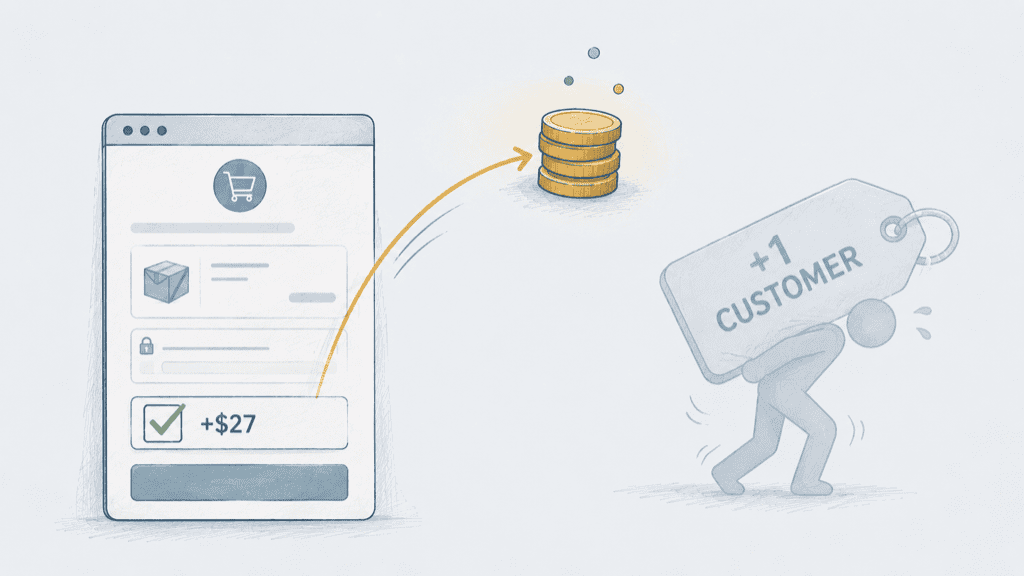
An order bump is a single optional checkbox on your checkout page. Next to it sits one or two lines offering a small extra product that goes with what the buyer is already getting. They check the box, the price is added to the order, and they finish checking out. There is no second sales page, no follow-up sequence, and no separate funnel to build.
You have almost certainly seen one yourself. “Add the quick-start guide for an extra $9.” “Include the bonus templates for $17.” It takes a buyer about two seconds to decide, and when the add-on is a good match, a fair share of them say yes.
Here is how the math works. Say a quarter of your buyers check the box, and the bump costs about a quarter of the main product. That adds roughly 6 percent to your revenue, which on a store doing $6,000 a month is about $375 extra every month, or around $4,500 a year, without a single extra visitor. A better match or a higher take rate pushes that number up from there.
Most sellers never add one because they assume a bump means building a whole second product, and that sounds like a project for “someday.” But there is a good chance you do not need to build anything new.
How to Set Up Your First Bump
The easiest way to add a bump is to use something you already have. There are four parts to it, and if you already have the asset and a checkout that supports bumps, you can get through all of them in an afternoon.
Step 1: Start With What the Buyer Just Bought
Most people start by asking “what else could I sell?” That is the wrong question, and it is the reason so many bumps flop. Start with the main product instead, and ask: what would make this purchase easier, faster, or more useful the moment it arrives?
The answer is your bump. It should feel like the natural other half of the purchase, not a separate idea competing for attention. A few ways to think about it:
- Gear and the guide. If you sell a physical product, the bump shows the buyer how to get the most out of it.
- The system and the shortcut. If you sell a course or a method, the bump is the templates or tools that make the method quicker to use.
- The item and its companion. If you sell something that wears out or needs looking after, the bump is the refill, spare, or care kit that goes with it.
Here is how that looks in practice:
| What They’re Buying | The Bump | Why They Go Together |
|---|---|---|
| A $45 pour-over coffee kit | A $9 brew guide with ratios for 12 different beans | The kit is the equipment, the guide is how to make it taste great |
| A $47 beginner email marketing course | A $17 swipe file of 50 tested subject lines | The course teaches the method, the swipe file speeds it up |
| A $60 garden pruning set | A $12 blade sharpener and cleaning kit | It is the thing a gardener would otherwise remember they need a month later |
Step 2: Find It in What You Already Have
Now go looking. Open the folders on your computer, your Google Drive, your old email drafts, and anything you have recorded or written while running your business. You are looking for things like:
- A training or webinar you recorded once and never reused
- A checklist or cheat sheet you made for yourself
- A set of templates, scripts, or swipe copy
- A short case study or before-and-after example
- A list of AI prompts that saves you time
- Notes from answering the same customer question again and again

If you sell physical products, also look at what you already stock or can easily source: a refill, a spare part, a care kit, a compatible accessory, or a sample pack of something else in your range.
None of it needs to be pretty, freshly branded, or new. The only test is this: would it have saved you time or frustration if someone had handed it to you when you started? If yes, it is a candidate. And if you come up empty, a short screen recording of your single best tip for using the main product is a good place to start.
Step 3: Price It So It Feels Like a Small Add-On
The bump should feel like a small add-on to the purchase the buyer is already making, not like a second decision. A good rule of thumb is to price it somewhere between 20 and 35 percent of the main product.
- Main product at $47, bump around $12 to $17
- Main product at $97, bump around $27
- Main product at $197, bump around $47
- Main product at $497, bump around $97
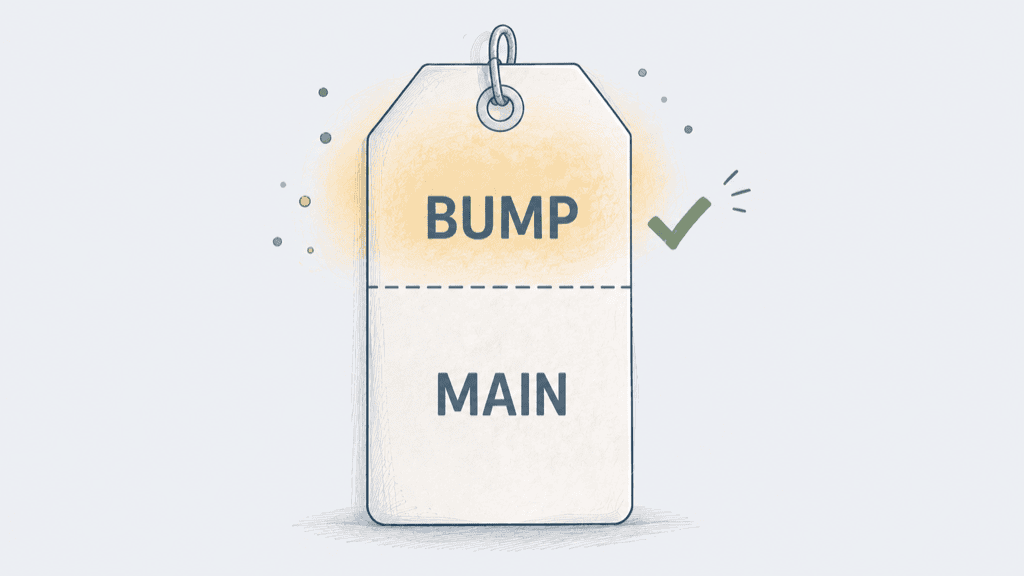
Price it much higher and buyers start to hesitate, while much lower just leaves money on the table. On a $97 product with a $27 bump, ten buyers checking the box is $270 you did not have to find a single new customer for.
Step 4: Keep the Box to Two Lines
The buyer is in the middle of paying, so this is not the place for a sales pitch. Long bump copy gets skipped. All you need is:
- A bold first line that says yes and names the price.
- One sentence that says what it is and what it does for them.
Something like this:
Yes, add the Brew Ratio Guide to my order for just $9. Twelve simple recipes so your first cup with the new kit tastes like it came from a coffee shop.
The buyer checks it or skips it, and the main sale carries on. Once it is live, keep an eye on two numbers for the first few weeks: how many buyers add the bump, and whether your overall checkout completion rate holds steady. If both look healthy, leave it running.
One Thing to Do Today
Open your checkout tool right now and check whether it has an order bump or “checkout add-on” setting. ThriveCart, SamCart, and Kajabi have one built in, and Shopify and WooCommerce can add one with an app or plugin. Once you have found it, write down your best-selling product and one thing from your folders that would make it easier or more useful. You do not have to switch anything on today. Just get the pairing decided, because that is the step that takes the most thinking.
“But What If…”
“What if I only sell other people’s products, like through affiliate links?”
You cannot add a bump to someone else’s checkout, but the same thinking still applies the moment you have anything of your own to sell, even a $7 guide. Many affiliates start exactly that way, with a small product of their own that has a bump attached.
“What if my checkout doesn’t support bumps?”
Look for an add-on first, because most platforms have one. If yours genuinely cannot do it, weigh the cost of switching against your order volume, because on a busy store a working bump can pay for a new checkout tool fairly fast.
“What if buyers find it pushy?”
A bump only feels pushy when it has nothing to do with what the person is buying. When it helps them get more out of their purchase, most buyers see it as a helpful offer, and the ones who do not want it simply leave the box unchecked.
Most sellers looking for more money look outward, at more ads and more followers. But some of the easiest money in your business is sitting right at your checkout, with buyers who have already decided to spend.
Give every buyer one more good reason to say yes, right at the moment they are already saying it.
Talk soon,
The Wholesale Formula team