

Here is a pattern I have watched play out hundreds of times. Someone starts an online business, works hard for a few weeks, and their dashboard lights up. Opens climbing, views ticking over, follower count creeping up. Everything on the screen says it is working. Then they check their bank account and nothing has moved.
That gap is where most people quit. Not because the business failed, but because they lost the ability to tell whether it was succeeding. The numbers they were watching looked healthy and their income looked dead, and after a few weeks of that mismatch the obvious conclusion feels like “this doesn’t work for me.”
It almost always does work. The problem is that the reader is reading the wrong gauge. And the dangerous part is that the wrong gauge feels completely trustworthy, because the platforms put it front and centre and it moves every single time you do something.
Why the Comforting Numbers Are the Ones Lying to You
If you have been tracking opens, page views, and follower counts, you are not doing anything odd. Those are the numbers every tool shows you by default, and they move the moment you post, send, or publish, so they feel like proof that your effort landed. You send an email, the open rate jumps, and your brain files that as progress.
The trouble is that those numbers measure machines and delivery, not human decisions. They tell you the email reached an inbox, the page loaded, the follow button got tapped at some point last year. What none of them tell you is whether one real person decided to do anything because of the work you put in. That is the only thing that ever turns into money, and it is the one thing these metrics hide.
The Three Numbers Doing the Most Damage
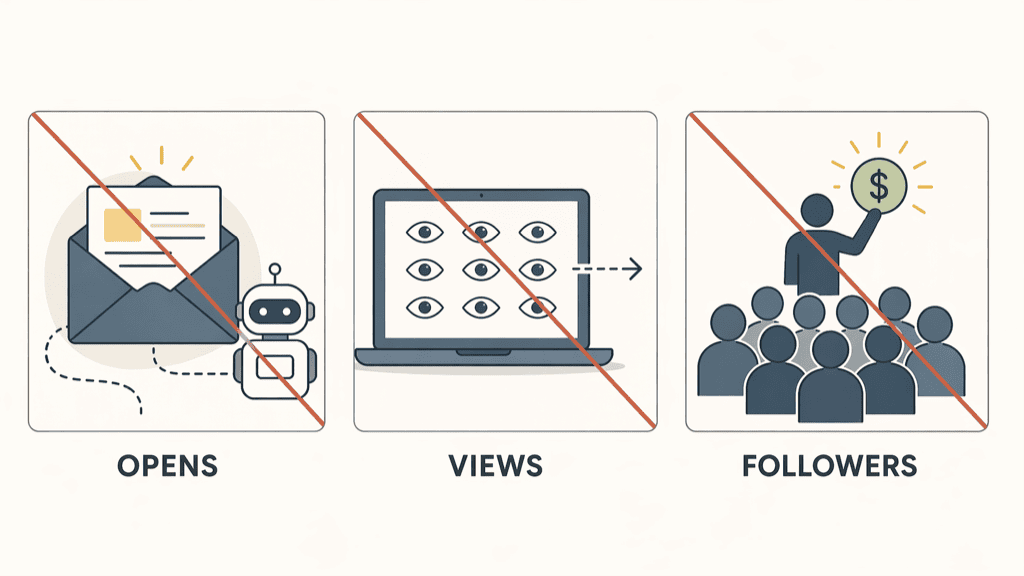
Three metrics cause more quiet discouragement than anything else I see in beginner setups. Here is why each one fools you.
-
Open rates. This is the most misleading number in email marketing right now, full stop. Apple Mail Privacy Protection downloads images in the background by default, whether a human reads the message or not, and Gmail caches images too, which can register as an open. So a 40% open rate is padded with opens no person ever made. I have reviewed lists showing 40% opens and a 0.3% click rate, and that is not a healthy list, it is a dead list wearing a costume. Nobody chooses to open. People do choose to click.
-
Page views. If you run a blog or affiliate content, traffic feels like the scoreboard. It climbs, you feel like you are winning. But traffic with no action pays no commissions, builds no list, and sells no product. You can have 10,000 people glance at a page and earn nothing, which happens far more often than anyone likes to say out loud.
-
Follower counts. This is the slowest to move, so every new follower feels earned. The catch is that 10,000 followers who never click, never buy, and never reply are 10,000 strangers. Audience size with no audience response is a photo of a crowd, not a business.
All three share one flaw. They measure whether your content showed up, not whether it worked.
The Money Signal: One Number Per Model
The fix is smaller than people expect. I call it your Money Signal, and the rule behind it is one line: pick the single number for your business model that sits closest to an actual dollar, and check it on the same day every week.

One number beats ten because ten numbers drifting in ten directions is noise, while one number moving in one direction is a signal you can act on. Track it weekly and you can read the trend in two or three weeks instead of guessing for six months and burning out in the meantime.
Step 1: Affiliate content, track clicks on your affiliate links
Your traffic report is full of interesting detail, but it cannot tell you whether anyone clicked through to the offer, and that click is the only number tied directly to commission. Find it in your affiliate dashboard, a link cloaker like Pretty Links, or whatever tracking you already run. If you publish five posts a month and only 1% of readers click through, that is a placement or offer problem, and it will never show up in your pageview count.
Step 2: Email marketing, track click-through rate
Opens lie, clicks tell the truth, because a click is a conscious choice a human made. Every email you send either earns a click or quietly teaches the reader to ignore you, and only one of those leads to a sale. Watch click-through rate instead of opens and you will quickly see which subject lines, stories, and calls to action actually pull people forward.
Step 3: Ecommerce, track add-to-cart rate
Page views will happily flatter you all day. Add-to-cart is the first moment a visitor actually decides something, and that decision is the leading indicator of every sale that follows. If your add-to-cart rate is stuck under 2%, that usually points to a product page problem rather than a traffic one, and doubling your ad spend will only pour more people into a leaky page.
Three Real-World Scenarios
Scenario one: the side-hustler emailing weekly. One of our students was watching a 42% open rate and had talked herself into believing things were working. When she looked at click-through instead, it was 0.5%. She rebuilt her next four emails around one clear call to action each, lifted clicks to 2.4% inside a month, and her first $600 affiliate month followed soon after.
Scenario two: the affiliate blogger. He was proud of 6,500 monthly page views and earning around $75. Once he tracked affiliate link clicks each week, he saw barely 1.1% of readers clicked anything. He moved his main links above the fold and rebuilt the opening of each post around them, and commissions roughly tripled over the next six weeks on the exact same traffic.
Scenario three: the Shopify store owner. She kept raising her ad budget and watching visits climb while sales stayed flat. When she finally checked add-to-cart rate, it sat at 1.6%. A quick audit found a broken size dropdown on her best-selling product, and after fixing it, add-to-carts climbed to 4% and her ad spend finally started paying.
Why This Matters
Time is the one asset you never get back. Every week you spend reading the wrong number is a week where you genuinely cannot tell whether your effort is working or wasted, and that uncertainty is what grinds people down. It is not that month two is when businesses fail. It is when people run out of patience waiting for a signal that was never going to come from opens and views.
A real Money Signal gives you that feedback in two to three weeks. That is the whole difference between “nothing is working, I’m done” and “this is moving, keep going.” It is also, more often than not, what keeps people going through the quiet stretch instead of walking away right before the work starts to pay.
Your 5-Minute Quick Win

Open whichever dashboard matches your business right now. Pick your Money Signal from the three above, and write today’s number down somewhere you will physically see it, whether that is a sticky note on your monitor, a pinned note on your phone, or a line in your planner. That number is your baseline.
Check the same number on the same day next week, then again the week after. Three data points is all it takes to see whether your effort is producing a signal or just noise, and you will have built the feedback loop most people never bother to install.
“But What If…”
“What if my Money Signal stays flat for three weeks?”
That is still a signal. A flat number is telling you the current approach is not landing, which means the next move is to change the offer, the audience, or the angle. Flat is not failure, it is information you can use.
“What if I run more than one business model?”
Pick one for now. Track the Money Signal for whichever model you most want to grow first, because splitting your attention across two signals just drops you back into the noise you are trying to escape. Add the second once the first is clearly moving.
“Do opens and page views not matter at all?”
They are useful as diagnostics once your Money Signal is already climbing. Rising clicks alongside rising opens is healthier than rising clicks with falling opens, and that kind of detail helps, but only once you have a real signal to anchor it to.
The number you choose to follow becomes the direction you walk. Point it at vanity and vanity is where you end up, which usually looks like a dashboard full of busy green lines and a bank balance that never moved.
The Wholesale Formula team